Content
Ensuring driving safety and preventing accidents continue to be top priorities in transportation. Traditional safety monitoring systems, including vehicle-based Advanced Driver Assistance Systems (ADAS) and roadside video surveillance, often fall short in offering comprehensive coverage or timely alerts. These systems face challenges such as limited spatial and temporal reach, lower accuracy, and delays in data transmission. Such shortcomings can result in late hazard warnings, which are critical in scenarios like lane departures or potential collisions. Moreover, these existing methods lack flexibility when adapting to the diverse levels of Connected and Automated Vehicles (CAVs) operating together on roads.
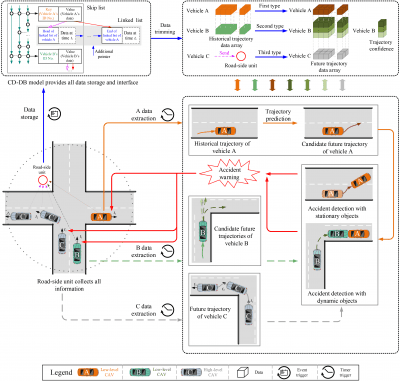
To address these problems, a collaborative research effort by Tsinghua University and Nebula Link Technology Co., Ltd. has developed a novel safety monitoring and warning framework leveraging V2X-based edge computing. This system hinges on a cooperative vehicle-infrastructure architecture that gathers real-time data from CAVs through Vehicle-to-Everything (V2X) communication channels, including Vehicle-to-Vehicle (V2V) and Vehicle-to-Infrastructure (V2I). The acquired data is then processed at edge computing nodes, closer to the data source, ensuring faster analysis and response.
The framework features four key components. First, vehicle and map data are efficiently stored using a CD-DB data structure integrated with skip lists and linked lists, facilitating rapid data retrieval and updates. Second, trajectory prediction employs three distinct algorithms tailored to different CAV maturity levels: Bezier curve extrapolation for low-level CAVs with sparse data, an attention-based multi-modal model for low-level CAVs with richer motion patterns, and direct utilization of self-predicted trajectories from high-level CAVs. Third, accident detection is conducted through a line intersection algorithm capable of assessing collisions between both moving and static objects. Lastly, the system triggers dynamic warnings based on the confidence levels of predicted trajectories and threshold-based judgments, ensuring timely alerts tailored to imminent risks.
Extensive validation of this system has been performed using the Interaction dataset, which includes complex traffic scenarios like ramp merging and urban intersections, alongside real-world trials at Beijing's Shunyi testing field. These evaluations revealed that the proposed framework maintains a True Positive Rate (TPR) above 80% despite acceptable measurement errors and can tolerate transmission delays up to 0.1 seconds without significant performance degradation. Notably, in dynamic collision warnings within intersection scenarios, CAVs equipped with this system achieved a 100% TPR, surpassing the 85-90% rates observed in conventional single-vehicle systems.
In summary, the research offers a robust and adaptive approach for comprehensive driving safety monitoring in mixed traffic environments, addressing the limitations of prior methods. By combining real-time V2X communication with edge computing and advanced predictive algorithms, the framework enhances hazard detection and warning efficiency, thus contributing to safer roadways as CAV adoption continues to grow.