Content
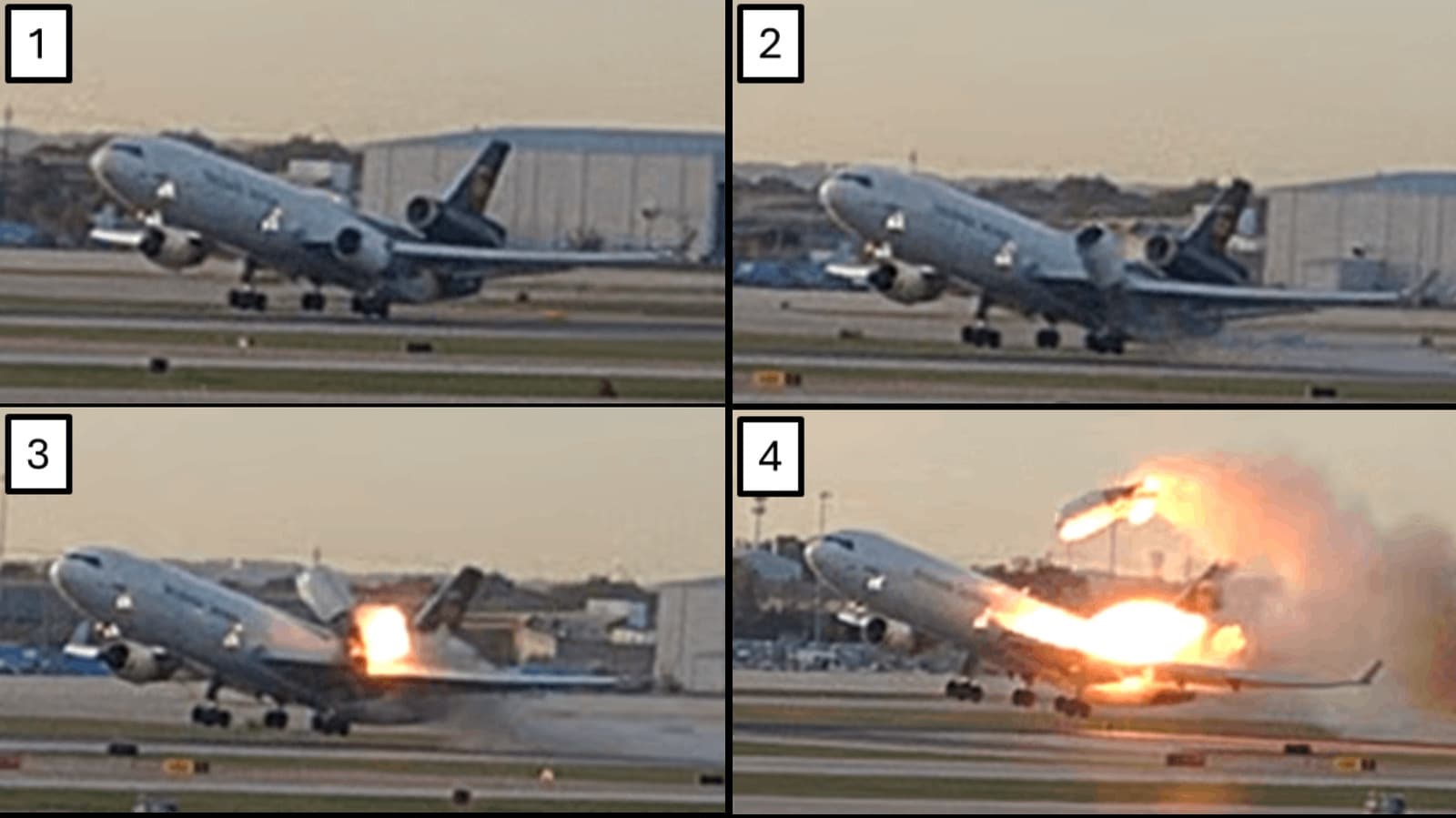
On November 4, 2025, UPS Airlines Flight 2976 departed from Muhammad Ali International Airport in Louisville, Kentucky, bound for Honolulu, Hawaii. Unfortunately, just after takeoff, the plane experienced a catastrophic fire on its left wing that led to a devastating crash. The accident resulted in the tragic deaths of 14 people and left 23 others injured in the ensuing fiery explosion. Following this tragedy, the National Transportation Safety Board (NTSB) released a preliminary report nearly three weeks later, attributing the cause to a cracked engine mount.
The report detailed the findings on the left pylon aft mount lug fractures, revealing fatigue cracks combined with overstress failures. Specifically, investigators found fatigue cracks where the aft lug bore met the aft lug forward face on both inboard and outboard fracture surfaces. The forward lug’s inboard fracture surface also showed fatigue cracks along the lug bore, while the forward lug’s outboard fracture surface displayed overstress failure without fatigue. Importantly, the forward top flange of the aft mount assembly was scrutinized for any signs of deformation or pre-existing fractures, but none were detected. Surveillance images included in the report show the engine and pylon breaking apart and separating from the left wing as the fire spread.
Regarding the crew, the pilot had 4,918 hours flying MD-11 aircraft with a total of 8,613 flight hours overall. The First Officer had 994 hours on MD-11s and 9,200 total hours, while the Relief Officer was highly experienced with 8,775 MD-11 hours and 15,250 hours total. Flight recorders were recovered, which will assist further in the ongoing investigation.
Given the cracked engine mount, one might suspect that maintenance was overlooked or inadequate. However, the NTSB’s preliminary findings suggest that UPS followed the required maintenance schedule. At the time of the crash, the aircraft had accumulated roughly 92,992 flight hours and 21,043 cycles. It was maintained under UPS's Continuous Airworthiness Maintenance Program (CAMP). The left pylon aft mount had undergone both a general and detailed visual inspection in October 2021, which is on a 72-month interval. A lubrication task for the pylon thrust links and spherical bearings was last performed just two weeks before the accident. Two special detailed inspections (SDI) related to the left pylon aft mount lugs and the left wing clevis support had not yet been due, as those were scheduled for 29,200 and 28,000 cycles respectively, and the aircraft only had 21,043 cycles at the time.
This raises questions about the adequacy of the manufacturer’s maintenance intervals. Since UPS adhered to the maintenance tasks prescribed by McDonnell Douglas but still missed these critical fatigue cracks, it’s possible that the inspection intervals recommended might be too lenient. While this issue is likely to be debated at length in the future, the Federal Aviation Administration (FAA) has already responded by grounding all MD-11 aircraft until thorough inspections can be completed. This grounding was later extended to include all DC-10 series airplanes, given their structural similarities to the MD-11.
The incident underscores the complex balance between prescribed maintenance protocols and real-world operational safety. It also highlights how aging aircraft may develop unforeseen fatigue issues, even when routine inspections are performed as scheduled. The ongoing investigation will no doubt influence future regulatory and maintenance frameworks for these aircraft types.