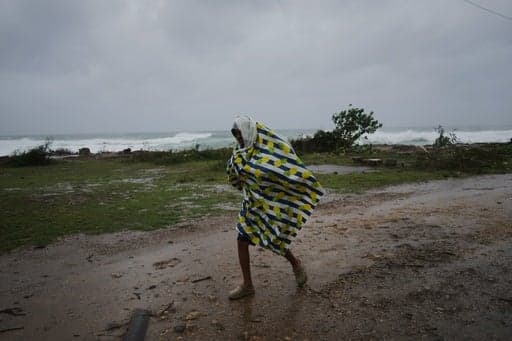
Hurricane Melissa weakens as it churns across Cuba as a Category 2 storm
Hurricane Melissa made landfall over Cuba on Wednesday as a Category 2 storm, having earlier battered Jamaica as one of the most intense Atlantic hurricanes recorded. The U.S. National Hurricane Center reported that Melissa's sustained winds reached up to 185 mph when it struck Jamaica, causing significant destruction. Tragically, at least one person died there when a tree fell on a baby in the island’s west, as confirmed by Jamaican state minister Abka Fitz-Henley. The storm's most severe damage was concentrated in Jamaica’s southwest and northwest regions. By Wednesday, Melissa had weakened but remained a powerful storm with sustained winds of 105 mph, moving north-northeast at 14 mph. It was positioned approximately 45 miles northwest of Guantánamo, Cuba, and 205 miles south of the central Bahamas. Authorities were urging rapid completion of storm preparations in the Bahamas due to expected impacts. Hundreds of thousands in Cuba had been evacuated to shelters as a hurricane warning was issued across multiple provinces including Granma, Santiago de Cuba, Guantánamo, Holguin, and Las Tunas, as well as in southeastern and central Bahamas. The storm was forecasted to continue weakening as it crossed Cuba but retain strength as it moved towards the Bahamas later in the day. By late Thursday, Melissa was expected to approach or pass west of Bermuda. Meanwhile, Haiti and the Dominican Republic were also preparing for the storm’s effects. Forecasters warned of a potential storm surge up to 12 feet in the region and heavy rainfall reaching up to 20 inches in parts of eastern Cuba. The intense rain raised concerns about life-threatening flooding and landslides, compounding challenges in Cuba, where the economy is already strained by power outages, fuel shortages, and food scarcity. Cuban President Miguel Díaz-Canel addressed the nation, emphasizing the severity of the storm, calling Melissa "the strongest ever to hit national territory." He stressed the need for vigilance and preparedness, acknowledging that the recovery ahead would be daunting. In Jamaica, however, officials faced difficulties in damage assessment due to widespread communication blackouts. Richard Thompson, acting director general of Jamaica’s Office of Disaster Preparedness and Emergency Management, highlighted that more than half a million customers were without electricity. Heavy flooding and downed trees and power lines affected much of Jamaica, especially in Clarendon and St. Elizabeth parishes. Hospital infrastructure also took a hit; four hospitals were damaged and one lost power, forcing the evacuation of 75 patients. Efforts were underway to reopen airports quickly to facilitate emergency supplies. The U.S. government responded by deploying disaster response teams and search and rescue personnel. The State Department authorized non-emergency U.S. government employees and families to leave Jamaica due to the storm's aftermath. Melissa has now been linked to seven deaths across the Caribbean, including three in Jamaica, three in Haiti, and one in the Dominican Republic, with an additional person missing. As the storm continues its path, authorities remain on high alert, emphasizing the importance of ongoing preparedness and swift relief measures to mitigate its impact. Key facts include Hurricane Melissa's progression as a Category 2 storm weakening over Cuba after striking Jamaica with record-high winds of 185 mph, causing multiple fatalities and widespread infrastructure damage. Geographically, the storm affected Jamaica, Cuba, the Bahamas, Haiti, and the Dominican Republic between late October and early November 2025. Direct stakeholders include residents, government agencies, and emergency response teams in the impacted Caribbean nations, while indirect effects reach regional economies and international aid organizations. Immediate impacts encompass large-scale evacuations, power outages affecting over half a million in Jamaica, hospital disruptions, and significant flooding and landslides expected in Cuba. Historical parallels can be drawn with Hurricane Gilbert in 1988, which similarly devastated Jamaica with intense winds and flooding, highlighting challenges in rapid damage assessment and emergency coordination. Looking forward, there are opportunities to enhance early warning systems and infrastructure resilience in hurricane-prone areas, but risks remain high given ongoing climate variability and resource constraints. Recommendations for regulatory authorities include prioritizing investment in communication networks to prevent blackout scenarios (high impact, medium complexity), strengthening building codes to withstand severe storms (high impact, high complexity), and expediting coordinated regional disaster response frameworks (medium impact, low complexity). This approach balances immediate needs with long-term resilience, ensuring preparedness for future cyclone events while addressing current vulnerabilities.