
If Intelligence Is Abundant, What is the Moat?
Publicado: May 7, 2026 at 02:22 PM
News Article
Contenido
Intelligence is becoming historically powerful, abundant, and cheap, yet practical AI adoption remains stalled. Recent data from MIT and IDC reveals that 95% of generative AI pilot programs fail and 88% of proof-of-concept projects never reach production. This discrepancy suggests that the competitive advantage in the AI era is no longer derived from higher benchmark scores or larger parameter counts, but from mastering organizational context.
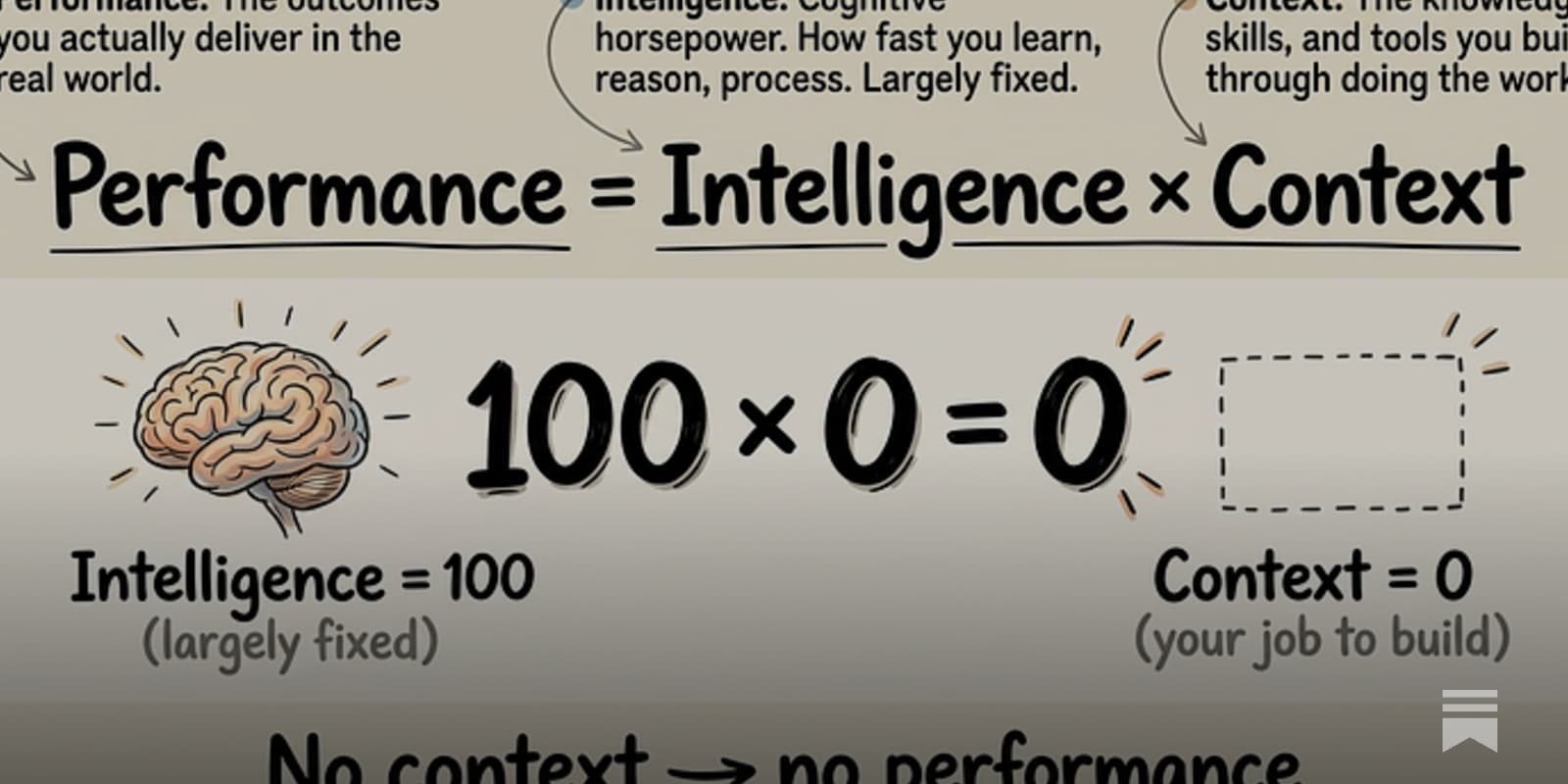
Performance in enterprise environments functions as a multiplicative relationship between intelligence and context. If an organization lacks specific situational knowledge, risk conventions, or historical precedents, even the most capable model yields zero performance. Conversely, high intelligence paired with incorrect context produces more elaborate and dangerous errors. Common failure scenarios include connectivity issues where data is fragmented across systems, semantic failures where terms like revenue mean different things to Sales versus Finance, and institutional knowledge gaps where unwritten rules override written manuals.
This perspective aligns with decades of cognitive science research, including theories on situated cognition and distributed intelligence. Experts argue that intelligence is a property of the system surrounding the individual, not just the individual themselves. Industry leaders are beginning to reflect this shift; for instance, recent reports highlight significant investments in world models that understand physics and context rather than merely predicting text. OpenAI’s internal experiences further confirm that successful agents require layers of context including table schemas, human annotations, and runtime queries.
The strategic frontier is moving from building reasoning engines to representing and maintaining organizational context. Companies that invest in governing their context infrastructure build a compounding advantage where subsequent AI deployments inherit previous knowledge. The ultimate measure of progress will shift from isolated model evaluations to situated assessments of how the entire system performs within the actual environment using messy, real-world data.
Perspectivas Clave
The primary takeaway is that raw AI model capability is becoming commoditized, rendering traditional benchmark scores insufficient for measuring enterprise value.
Success now hinges on integrating organizational-specific knowledge, which acts as a non-commoditizable barrier to entry.
While investing in context infrastructure offers compounding returns, organizations face significant challenges in capturing tacit knowledge without established frameworks.
Uncertainty remains regarding the scalability of these context systems across different domains.