
50+ Digital Business Models Map & Examples 2026 - FourWeekMBA
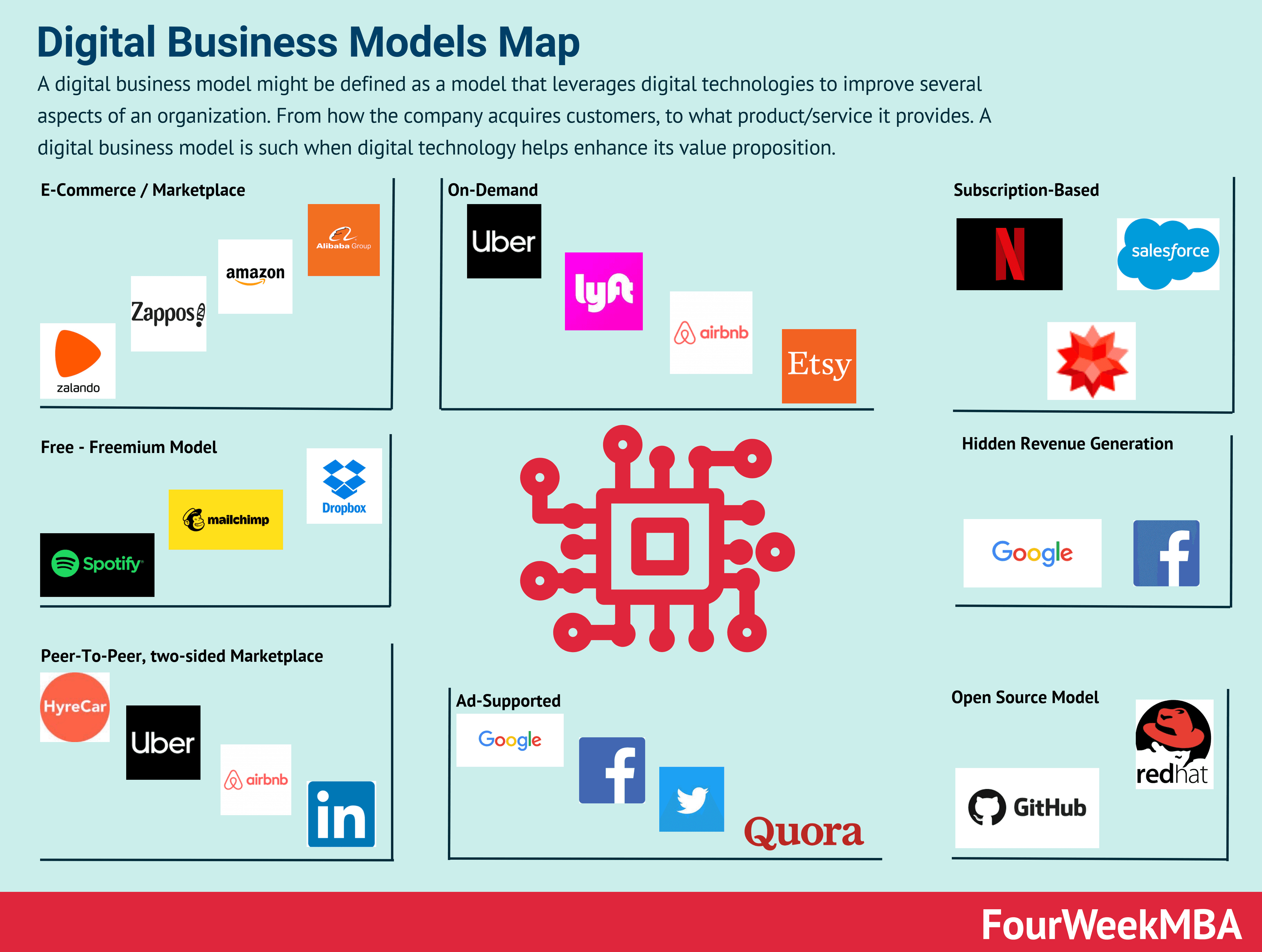
FourWeekMBA has officially released an updated comprehensive guide to digital business models, titled 50+ Digital Business Models Map & Examples 2026. Published in April 2026, the resource catalogs 14 distinct model categories and provides over 70 company examples, reflecting a combined market capitalization exceeding $10 trillion as of 2025 data. The update focuses heavily on the integration of artificial intelligence into established economic frameworks. The guide identifies three primary AI-native business models shaping the current landscape: Foundation Model APIs, AI Copilots, and Autonomous AI Agents. Companies such as OpenAI, Anthropic, and Microsoft are highlighted for monetizing intelligence through usage-based pricing and premium add-ons embedded in existing workflows. These models represent a shift from tools to autonomous workers, requiring significant capital expenditure in chips and cloud infrastructure. Traditional market leaders continue to demonstrate the viability of hybrid approaches. Amazon generated nearly $575 billion in revenue in 2023, with online stores contributing over 40% alongside third-party seller services and AWS. Similarly, Netflix reported $33.7 billion in revenue for 2023, relying on original content production to maintain subscriber retention. Google parent company Alphabet generated over $175 billion specifically from Google Search advertising in 2023, reinforcing the dominance of attention-based monetization. Strategic analysis within the document debunks common myths regarding digital innovation. It argues that digital transformation is not merely about product delivery or distribution channels but requires a holistic value proposition. The text cites McDonald’s franchising model as an example of leveraging consolidated systems for scale, noting that successful digital businesses often start simple before evolving into complex platforms. The authors warn that many new digital models may prove fragile over long horizons without sufficient cash buffers. The publication concludes by recommending a mix-and-match approach to business design. Rather than adhering to a single formula, organizations are advised to test combinations of open-source, freemium, and subscription elements. This flexibility allows companies to adapt to changing technological paradigms while maintaining financial sustainability across different stages of growth.
公開日: June 4, 2026 at 03:56 AM
News Article
コンテンツ
FourWeekMBA has officially released an updated comprehensive guide to digital business models, titled 50+ Digital Business Models Map & Examples 2026. Published in April 2026, the resource catalogs 14 distinct model categories and provides over 70 company examples, reflecting a combined market capitalization exceeding $10 trillion as of 2025 data. The update focuses heavily on the integration of artificial intelligence into established economic frameworks.
The guide identifies three primary AI-native business models shaping the current landscape: Foundation Model APIs, AI Copilots, and Autonomous AI Agents. Companies such as OpenAI, Anthropic, and Microsoft are highlighted for monetizing intelligence through usage-based pricing and premium add-ons embedded in existing workflows. These models represent a shift from tools to autonomous workers, requiring significant capital expenditure in chips and cloud infrastructure.
Traditional market leaders continue to demonstrate the viability of hybrid approaches. Amazon generated nearly $575 billion in revenue in 2023, with online stores contributing over 40% alongside third-party seller services and AWS. Similarly, Netflix reported $33.7 billion in revenue for 2023, relying on original content production to maintain subscriber retention. Google parent company Alphabet generated over $175 billion specifically from Google Search advertising in 2023, reinforcing the dominance of attention-based monetization.
Strategic analysis within the document debunks common myths regarding digital innovation. It argues that digital transformation is not merely about product delivery or distribution channels but requires a holistic value proposition. The text cites McDonald’s franchising model as an example of leveraging consolidated systems for scale, noting that successful digital businesses often start simple before evolving into complex platforms. The authors warn that many new digital models may prove fragile over long horizons without sufficient cash buffers.
The publication concludes by recommending a mix-and-match approach to business design. Rather than adhering to a single formula, organizations are advised to test combinations of open-source, freemium, and subscription elements. This flexibility allows companies to adapt to changing technological paradigms while maintaining financial sustainability across different stages of growth.
編集者のおすすめ
利用可能な製品がありません