Artificial Intelligence versus Machine Learning: SME Guide
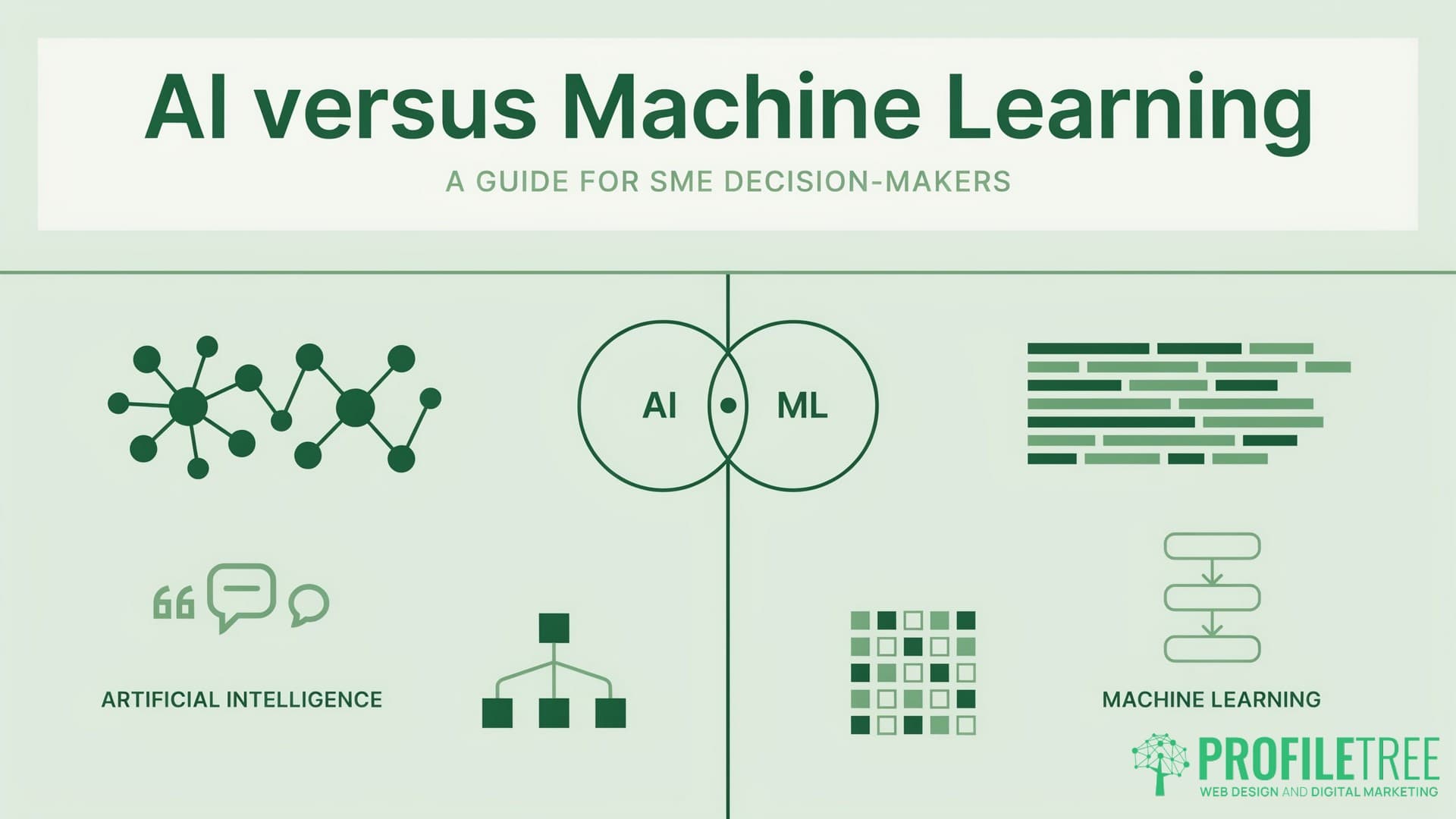
A new guide released for small and medium enterprises in the United Kingdom and Ireland establishes that machine learning is a subset of artificial intelligence, defining the parent-child relationship critical for budget allocation. While the terms are often used interchangeably in vendor pitches and boardroom presentations, the distinction determines whether a business adopts broad reasoning systems or narrow pattern-learning tools. Understanding this hierarchy helps decision-makers evaluate where to invest resources, moving beyond terminology to identify specific solutions for operational problems. Artificial intelligence refers to computer systems performing tasks requiring human-like reasoning, such as language understanding or image recognition. In contrast, machine learning trains itself by processing datasets to identify patterns without explicit programming for every scenario. Typical entry points for SMEs differ accordingly; artificial intelligence often manifests through SaaS tools like ChatGPT or Canva AI for content generation, whereas machine learning is frequently embedded within platforms like Shopify or HubSpot for recommendations and churn prediction. The technology stack further divides into deep learning, a subset of machine learning utilizing multi-layered neural networks. This foundation powers large language models and generative AI tools currently accessible to businesses without needing to build custom infrastructure. For most SMEs, practical application involves using these ready-made outputs rather than developing bespoke models, though success depends on whether the underlying data is clean and structured enough to support predictive analytics. Regulatory considerations also shape adoption strategies across the region. The EU AI Act applies in Ireland and impacts Northern Ireland businesses trading with the Republic, classifying systems by risk levels such as hiring decisions or credit scoring. Meanwhile, the UK employs a sector-led, principles-based framework overseen by regulators like the ICO and FCA. Businesses operating on both sides of the border must navigate GDPR obligations regarding personal data processing and automated decision-making transparency. Implementation advice emphasizes starting with existing platform capabilities before pursuing custom development. ProfileTree founder Ciaran Connolly notes that the priority should be solving specific business problems rather than choosing abstract technologies. Successful adoption requires team training and auditing current workflows to ensure internal understanding matches the technological rollout, treating AI as a capable team member that augments human judgment rather than replacing it.