
Gradient descent (Artificial Intelligence) - Definition - Meaning - Lexicon & Encyclopedia
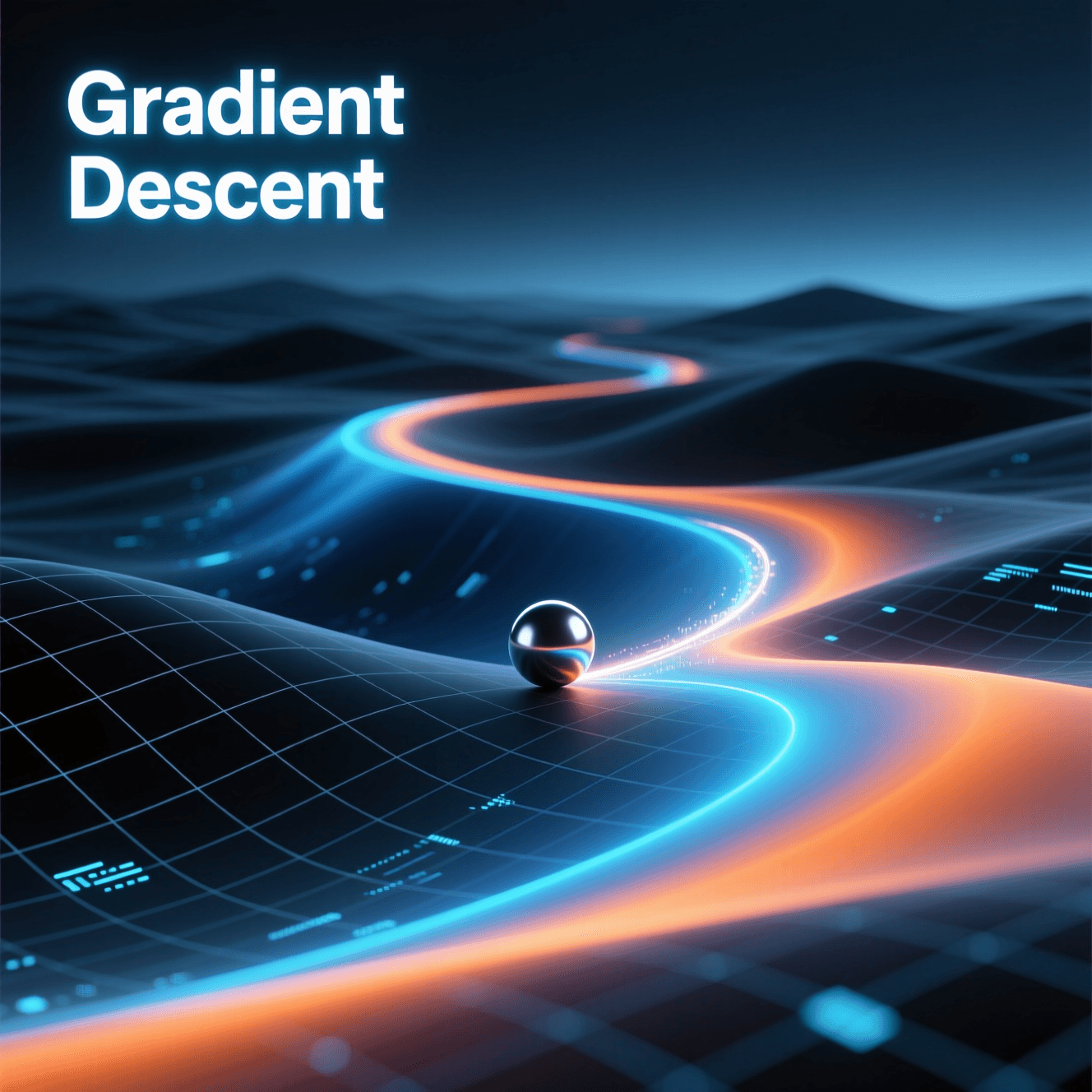
Gradient descent is a fundamental technique in machine learning, acting as a core optimization routine for nearly all modern models. As a first-order, iterative method, it updates approximate solutions by taking steps proportional to the negative of the gradient. This process allows algorithms to find the minimum of a function, effectively reducing the error produced by the network. In the context of neural networks, the algorithm computes gradients of loss with respect to the model's parameters. Variations such as Stochastic Gradient Descent are frequently employed during the training phase to learn network parameters efficiently. The method relies on a learning rate value to multiply with the gradient at each iteration, determining the step size toward the optimal solution. By moving weights and biases in the direction where they have the greatest impact on error reduction, the algorithm gradually finds the best combination of parameters. This approach minimizes loss functions, whether quadratic for linear regression or more complex forms for deep learning structures. Understanding these mechanics is essential for interpreting how artificial intelligence systems adapt to data.
公開日: June 20, 2026 at 02:48 PM
News Article
コンテンツ
Gradient descent is a fundamental technique in machine learning, acting as a core optimization routine for nearly all modern models. As a first-order, iterative method, it updates approximate solutions by taking steps proportional to the negative of the gradient. This process allows algorithms to find the minimum of a function, effectively reducing the error produced by the network.
In the context of neural networks, the algorithm computes gradients of loss with respect to the model's parameters. Variations such as Stochastic Gradient Descent are frequently employed during the training phase to learn network parameters efficiently. The method relies on a learning rate value to multiply with the gradient at each iteration, determining the step size toward the optimal solution.
By moving weights and biases in the direction where they have the greatest impact on error reduction, the algorithm gradually finds the best combination of parameters. This approach minimizes loss functions, whether quadratic for linear regression or more complex forms for deep learning structures. Understanding these mechanics is essential for interpreting how artificial intelligence systems adapt to data.
編集者のおすすめ
利用可能な製品がありません